Source A
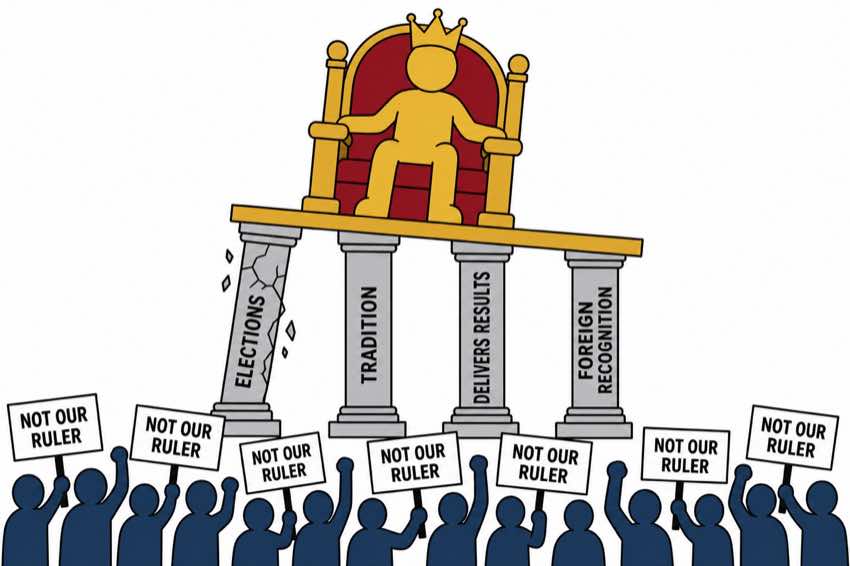
Source B
Adapted from "Where Authority Comes From: The Foundations of Political Legitimacy," International Governance Review, 2021.
Legitimacy is the widely held belief that an authority has the right to rule and that its commands ought to be obeyed. It is distinct from raw power: a regime may control territory through force yet still be seen as illegitimate by those it governs. Scholars identify several overlapping sources. Some rulers draw on tradition and long-established custom; others on a charismatic leader who inspires personal loyalty. In most modern states, legitimacy rests on legal-rational foundations: leaders gain office through constitutional rules and competitive elections, and citizens accept their authority because the process is seen as fair. A further source is performance, or "output" legitimacy: governments that deliver security, prosperity and public services can earn acceptance even where democratic procedures are weak. Because these sources overlap, the erosion of one need not be fatal, but a regime that loses several at once faces a crisis of authority.
Source C
Adapted from "Recognition Denied: The Taliban and Myanmar's Generals," Journal of Contemporary Statehood, 2023.
Two regimes that seized power by force have struggled to convert control into acceptance. When the Taliban recaptured Kabul in August 2021, they controlled almost all of Afghanistan's territory, yet by 2023 no state had granted them full diplomatic recognition; their seat at the United Nations remained held by representatives of the ousted government. Their exclusion of women from secondary education and public life became a central obstacle to international acceptance. Myanmar's military, which overturned the 2020 election result and detained the elected leadership in February 2021, faced mass civil disobedience, armed resistance and near-total loss of domestic legitimacy. In both cases, effective control of the state did not produce the recognition, at home or abroad, that the rulers sought. Authority imposed by force, these examples suggest, is not the same as authority that is accepted.