Question
View answerHLPaper 1
Consider the limit .
Consider the limit .
Consider .
This question investigates the convergence and divergence of improper integrals: integrals whose upper limit extends to infinity. Through specific examples, you will develop a general test for convergence and then apply it to integrals that cannot be evaluated directly.
Consider the improper integral , which is defined as .
On the interval the function satisfies
Let and consider the curve for .
Practice IB Mathematics Analysis and Approaches (AA) Topic AHL 5.13—limits and L’hopitals with authentic exam-style questions for both SL and HL students. This question bank focuses on the exact syllabus content for AHL 5.13—limits and L’hopitals and mirrors Paper 1, 2, 3 style where relevant.
Get instant solutions, detailed explanations, and build confidence with questions aligned to IB examiner expectations.
Show that the limit is indeterminate and l'Hôpital’s rule twice.
Evaluate the limit by applying l'Hôpital’s rule a third time.
Hence show that .
Now consider .
Show that does not converge to a finite value.
The results above suggest that the convergence of depends on the value of . In this section you will exactly when this integral converges.
Show that when , .
why diverges when .
The function arises frequently in mathematics and statistics. It does not have an antiderivative that can be expressed in terms of elementary functions, so cannot be evaluated using standard integration techniques. However, it is still possible to whether this integral converges.
Hence show that for all .
Show that .
Using the results from parts 9 and 10, why must converge to a finite value.
The technique used in part 12, bounding an unknown integral by a known convergent one, can be applied more broadly. Consider the function
Find an integrating factor for this equation, and hence show that its general solution is , where is an arbitrary constant.
For that solution, find the exact value of .
For , let be the area of the region enclosed by this curve and the -axis for .
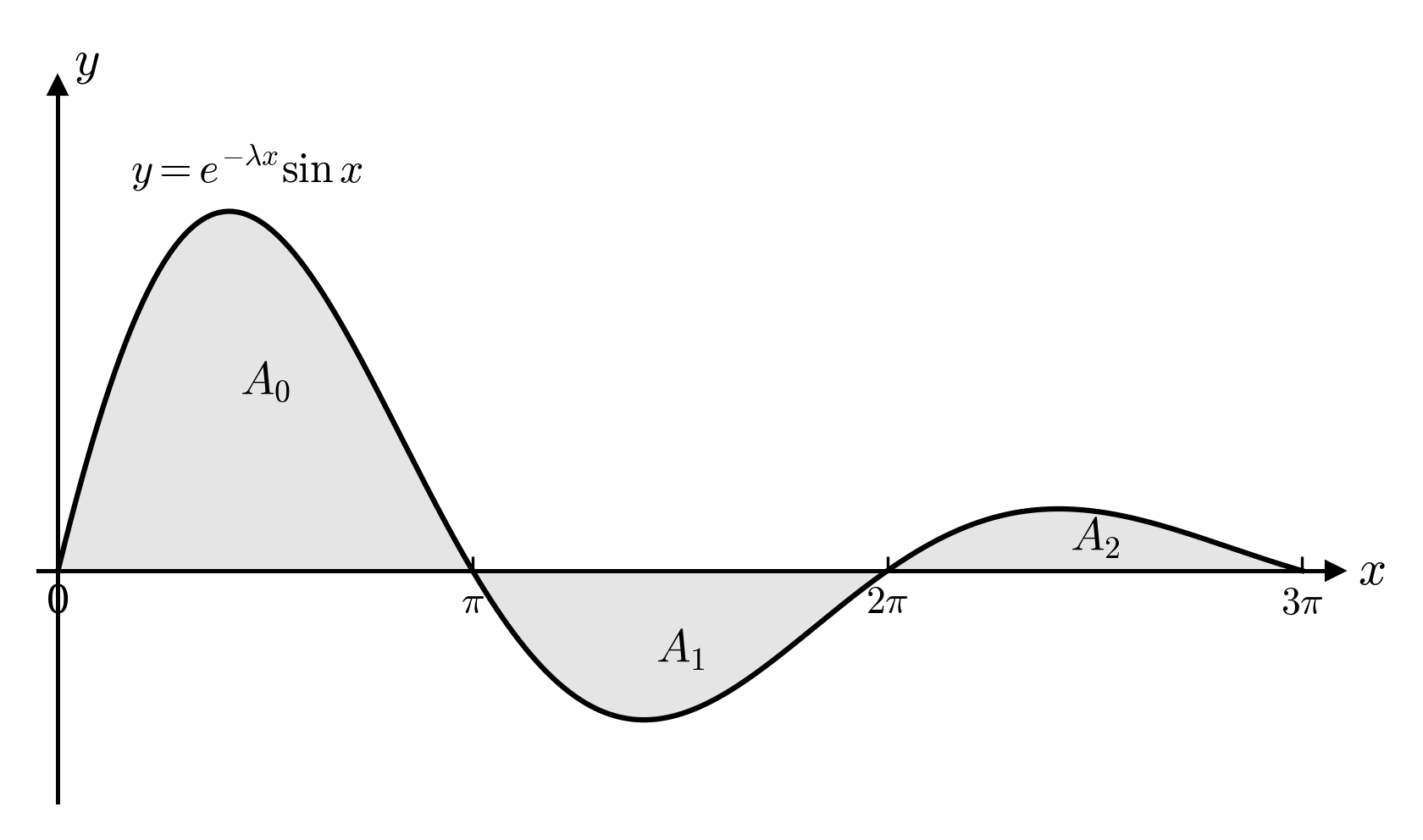
For and , show that
Consider the inequality .
Show that for all .
By finding a suitable comparison function whose improper integral converges, show that converges. an upper bound for the value of this integral.
