

UK University admissions can feel like this: one minute you’re revising vectors or structuring a Paper 2 essay, and the next minute someone asks you to choose “five options” that might shape the next three years of your life.
The strange part is that the biggest moments rarely look dramatic. A teacher uploads predicted grades. A referee writes two paragraphs. You press submit. Then a University you’ve pictured for months answers with a single word.
If you’re an IB student preparing for exams, that simplicity can be calming or terrifying. This guide makes it calmer. You’ll understand how UK University admissions actually works, what UCAS does (and doesn’t do), why requirements are strict, and how to protect your revision momentum while you apply.
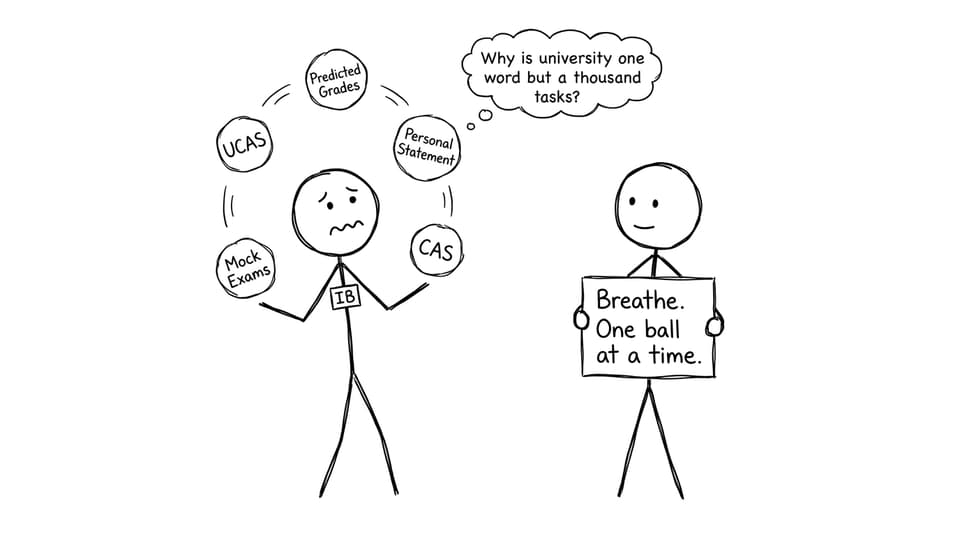
The UK University admissions checklist (save this)
Before you get lost in tabs, keep one short checklist. UK University admissions is mostly predictable if you treat it like an exam process: criteria first, then evidence.
-
Confirm your course choices and check each University’s entry requirements
-
Create your UCAS account and fill in your details early
-
Understand you can apply for up to five University choices on UCAS
-
Plan your personal statement (or the upcoming structured questions)
-
Choose your referee and give them time
-
Protect predicted grades with consistent, timed practice
-
Track deadlines and respond quickly to updates
If you want a broader global view (UK vs US vs others), keep this open in another tab: How to Apply to University as an IB Student.
UCAS: the system that makes UK University admissions feel “one-click”
UCAS (Universities and Colleges Admissions Service) is the central application portal for most UK University applications. The practical win is real: you fill in your core information once, and you can apply to up to five University choices without recreating everything from scratch.
UCAS is also a search tool. You can look up courses, see typical offers, and sanity-check whether you’re aiming at the right level. Still, treat it like a map, not the territory: always verify details on the specific University and department page, because small differences (a required HL, a specific grade) matter.
When you start drafting your application, it helps to understand how the pieces fit together. This breakdown is worth skimming: UCAS Application Structure Explained.
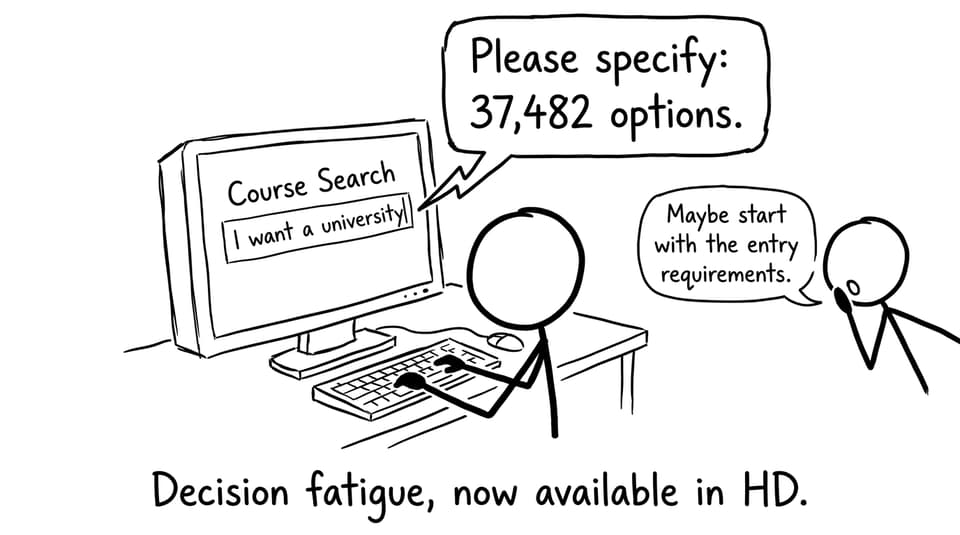
University entry requirements: specific, public, and usually strict
UK University admissions is unusually direct about grades. Many courses publish typical offers like “36 points with 766 at HL” or “38 points with 777 at HL.” That clarity is a gift. It means you can stop guessing and plan.
But the clarity comes with a sharp edge: selective programs often treat requirements as a real threshold, not a friendly suggestion. Miss the mark by one point, and you may not be considered competitive (especially for the most oversubscribed courses). This is why UK University admissions feels “fast” to many IB students. Decisions can follow quickly when the academic profile does not match what the course expects.
If you’re curious how universities interpret IB rigor overall, this context helps: What Do Universities Think of the IB Diploma? and Why IB Scores Matter for Top Universities.
How to handle strict requirements without spiraling
A healthy approach is to build a University list with three layers:
-
Safe: you clearly meet the typical offer
-
Match: you are close and have a realistic path via predicted grades and exam performance
-
Reach: you meet or slightly miss today, but you are improving fast (and can prove it)
To keep it grounded, use evidence. RevisionDojo’s IB Grade Calculator can help you translate your current marks into a realistic points picture, which is far more useful than motivation speeches.
The teacher reference: one voice, so choose it wisely
Most UK University applications include a reference written by a teacher (your referee). Typically, you nominate one referee, so the choice matters.
Pick someone who can do three things:
-
Speak credibly about your academic ability
-
Connect your strengths to your chosen course
-
Provide specific examples (not generic praise)
If your intended University course is closely tied to a subject (for example, Geography with ESS, Engineering with Physics and Math, or Medicine with Biology and Chemistry), a subject teacher often writes the strongest reference. But a form tutor or another teacher can work if they know your work well and can be specific.
The simple strategy: give your referee a one-page “evidence sheet.” Include your target University course(s), why you want them, your strongest assignments, and any relevant EE/IA work. Make their job easy, and your reference usually gets better.
The personal statement (and the big change coming)
The UCAS personal statement has historically been a single piece of writing (up to 4,000 characters / 47 lines) sent to all five University choices. It’s not a US-style life story. It’s closer to an academic narrative: curiosity, evidence, reflection.
A useful split many students follow is:
-
Mostly academic interest (what you explored, read, questioned, tried)
-
Some relevant experience (projects, work experience, societies)
-
A small amount of broader extracurriculars (only if they support the course)
For structure help, these guides are practical:
What about the new UCAS format?
For 2026 entry and beyond, UCAS is moving toward structured questions instead of one long personal statement. The core intent stays the same: University admissions still wants to know if you understand the subject, can handle the work, and have a genuine reason for applying. The format just makes that clearer and, for many students, less intimidating.
Why IB students are often well-positioned for a UK University
IB is difficult in a very specific way: it forces you to keep performing across months, not just on one lucky day. UK University admissions tends to respect that.
Three common advantages IB students can lean on:
You already have “University-style” writing muscles
Between TOK, IAs, and the EE, you’ve practiced sustained arguments and structured thinking. That becomes tangible proof in a University application when you describe what you investigated and what changed your mind.
You have built-in academic evidence for your statement
A strong EE or IA is more than coursework. It’s a story about method: what you tried, what failed, how you improved. UK University admissions likes method.
You can show readiness through predicted grades and trajectory
UK offers are often conditional, which means the University is betting that your final results will match your predicted profile. Your job is to make that bet feel safe.
How to protect your predicted grades while preparing for exams
Here’s the part students don’t say out loud: applying to a University is mostly admin, but it can quietly steal revision time.
So set boundaries and use a system.
-
Use Study Notes to patch confusion quickly, not to rewrite textbooks. Try: Digital IB Study Notes You Can Access Anywhere.
-
Use Flashcards for daily recall, especially when applications drain your energy. Start here: How to Use Flashcards Effectively.
-
Use a Questionbank to turn knowledge into marks. (RevisionDojo’s Questionbank is designed for that loop.)
-
Use AI Chat when you’re stuck on a specific misconception at 11:30 p.m. and need a calm explanation.
-
Run weekly timed practice with Mock Exams and Predicted Papers so your confidence is earned.
If your predicted grades are stressing you out, read this slowly: IB Predicted Grades Don’t Define You (Here’s What Does).
Closing: make your University plan boring (so your results can be exciting)
A UK University application looks dramatic from the outside, but it’s mostly a series of ordinary steps done on time: UCAS details, realistic choices, a clean reference, and writing that sounds like a thinking student rather than a marketing brochure.
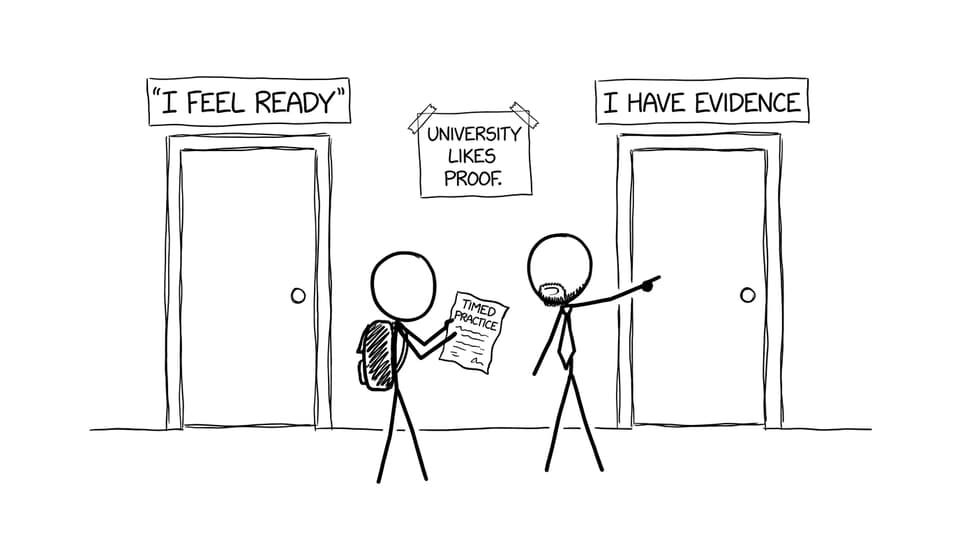
The students who do best are rarely the ones with the loudest confidence. They’re the ones with the most evidence. Evidence from timed practice. Evidence from a clear personal statement. Evidence that their predicted grades are not hope, but a trajectory.
If you want that evidence loop in one place, RevisionDojo is built for it: Questionbank practice when you need marks, Study Notes when you need clarity, Flashcards for daily recall, AI Chat for fast help, and realistic training through Predicted Papers and Mock Exams. Add Grading tools, the Coursework Library, and Tutors when you need deeper feedback, and your University goal stops being a fantasy and becomes a plan.
Keep your UCAS tabs open. Keep your revision routine smaller than you think it “should” be. Then repeat it. University offers tend to follow consistency.