


September often begins with clean notebooks and optimistic timetables. A few months later, deadlines overlap, test results arrive, and the friend who seemed fine may start withdrawing.
If you want to support a friend who's struggling this term, begin simply: notice the change, ask how they are, listen without trying to solve everything, and help them reach an appropriate adult when necessary. You do not need perfect words. You need patience, attention, and enough honesty to recognise what friendship can and cannot carry.
For IB students, academic pressure and emotional wellbeing often become tangled together. A disappointing grade can look like an academic problem while hiding exhaustion, anxiety, loneliness, or circumstances you know nothing about.
A quick support checklist
Keep these principles in mind:
- Choose a private, unhurried moment to speak.
- Mention what you have noticed without diagnosing them.
- Ask open questions and allow time for an answer.
- Find out whether they want listening, practical help, or both.
- Offer one manageable next step instead of ten suggestions.
- Encourage support from a trusted adult or professional.
- Act immediately if you believe anyone is in danger.
- Protect your wellbeing with reasonable boundaries.
These steps apply whether your friend is falling behind academically, feeling emotionally overwhelmed, or simply not seeming like themselves.
Notice patterns, not isolated bad days
Everyone has difficult afternoons. Concern becomes more important when a change continues or starts affecting ordinary life.
Your friend might repeatedly miss lessons, stop replying, abandon activities they enjoy, become unusually irritable, struggle to concentrate, or describe every task as hopeless. Their sleep, appetite, appearance, or attendance may change. These signs do not reveal exactly what is happening, and you should not diagnose them. They are reasons to check in.
An IB student can still look productive while quietly losing control of coursework, sleep, and motivation. RevisionDojo's guide to mental health resources for IB students explains how school counsellors, wellbeing teams, teachers, and coordinators can help.
Start a conversation without interrogating them
Choose somewhere reasonably private where neither of you needs to rush away. Walking home, sitting outside during lunch, or talking after a study session may feel less intense than arranging a formal meeting.
Begin with an observation rather than an accusation:
“You haven't seemed like yourself recently, and I wanted to check how you're doing.”
You could also say, “I've noticed you've been missing class and seem overwhelmed. Do you want to talk about it?”
Avoid claiming to know the cause. “You are burned out” closes possibilities. “You seem exhausted lately” gives your friend room to explain, correct you, or say they are not ready.
If they do not want to talk, do not force disclosure. Tell them the invitation remains open and check in later. Consistency usually communicates care better than one dramatic conversation.
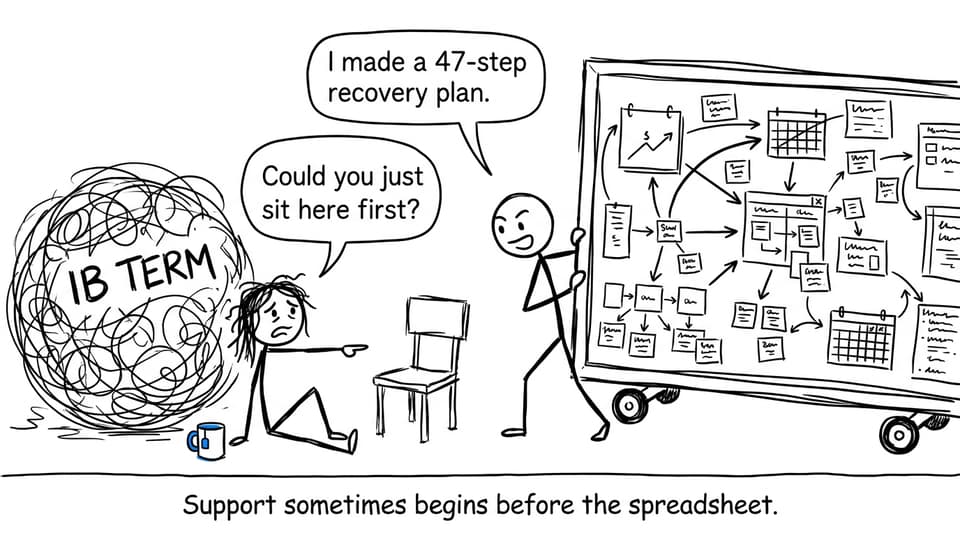
Listen before creating an IB rescue plan
Students often respond to distress by becoming project managers. We build a calendar, reorganise six folders, recommend three apps, and accidentally give the struggling person another assignment.
Ask one clarifying question first:
“Would it help more if I listened, helped you plan, or stayed while you started?”
Listen without interrupting or comparing. Responses such as “That sounds difficult” acknowledge their experience without pretending you completely understand it.
Avoid quick reassurance like “Everyone is stressed” or “You'll be fine.” These phrases can make someone feel their difficulty is unworthy of attention. Try something specific instead: “You don't have to solve the whole term tonight. What feels heaviest right now?”
Offer small, practical help
When someone is overwhelmed, the size of a task can matter more than its difficulty. “Catch up in Biology” feels endless. “Review one concept for 20 minutes” has an endpoint.
Useful support could include:
- sitting nearby while they email a teacher;
- listing deadlines by urgency;
- sharing legitimate notes from a missed lesson;
- joining them for one quiet study block;
- walking with them to a counsellor or coordinator;
- choosing one realistic task for today;
- inviting them to eat, walk, or rest.
If academic confusion is driving the stress, offer structured help rather than becoming their unpaid tutor. RevisionDojo's IB resource hub brings Study Notes, Flashcards, Questionbank practice, and AI Chat together. A friend who feels paralysed could read one section of digital IB study notes, clarify one idea through AI Chat, and answer a few focused questions.
For coursework pressure, Grading tools and the Coursework Library can make expectations clearer. Predicted Papers and Mock Exams are useful for deliberate preparation, but they should not become another obligation during an overwhelmed evening. Sustained difficulties may require a RevisionDojo Tutor or school teacher.
A short reset can also make the coming week visible:
| Area | One manageable action |
|---|---|
| Deadlines | List what is due before next Monday |
| Communication | Email one teacher about the urgent problem |
| Study | Complete one 25-minute focused block |
| Recovery | Choose a firm stopping time tonight |
| Support | Arrange a conversation with a trusted adult |
The aim is not immediate perfection. It is reduced uncertainty. The IB study material organisation guide can help untangle scattered resources. Keep ordinary friendship alive too. Talk about music, share lunch, or continue a routine they enjoy.
Know when friendship is not enough
You are a friend, not a therapist, crisis service, or sole support system. Encourage your friend to approach a parent or caregiver, school counsellor, IB coordinator, trusted teacher, doctor, or qualified mental health professional when distress persists or disrupts daily life.
If your friend says they may hurt themselves or someone else, cannot stay safe, or appears to be in immediate danger, contact a trusted adult and local emergency or crisis services immediately. Stay with them if it is safe. Do not promise secrecy when safety is involved.
Healthy support also has limits. You can say, “I care about you, but I can't stay awake messaging all night. Let's contact someone who can support you properly.” Continue protecting your sleep, work, and emotional health. RevisionDojo's guide to managing IB stress can help separate productive preparation from frantic activity.
Be the friend who returns
A single conversation matters, but the quieter follow-up may matter more. Send a message the next day. Ask how the teacher meeting went. Invite them for a walk or short study session without making every interaction a wellbeing assessment.
RevisionDojo can reduce academic fog through its Questionbank, Study Notes, Flashcards, AI Chat, Grading tools, Predicted Papers, Mock Exams, Coursework Library, and Tutors. Yet the first resource a struggling student may need is simpler: a friend who notices, listens, and knows when to bring someone else into the room.