


The International Baccalaureate has published a new Biology data booklet for first assessment in 2028. The booklet affects both Standard Level and Higher Level students and will be available during the course and in the written examinations.
The Version 1.0 document, published in May 2026, contains physiology diagrams, equations, constants, symbols, statistical references and other Biology data. For students taking their first examinations in 2028 or later, the change reduces the need to memorize some reference material but increases the importance of locating and applying information accurately.
Key facts about the IB Biology booklet
-
First assessment: 2028
-
Students affected: Biology SL and Biology HL candidates following the 2028 course
-
Course use: Students must have access to a copy throughout the course
-
Exam use: Each student must receive a clean copy during the written examination papers
-
Version identified in the document: Version 1.0
-
Publication date stated by the IB: May 2026
-
School responsibility: Schools download and provide copies through IBIS or the Programme Resource Centre
The booklet accompanies the DP Biology guide and teacher support material. It is not a replacement for the subject guide or a Biology textbook.
What the Biology data booklet contains
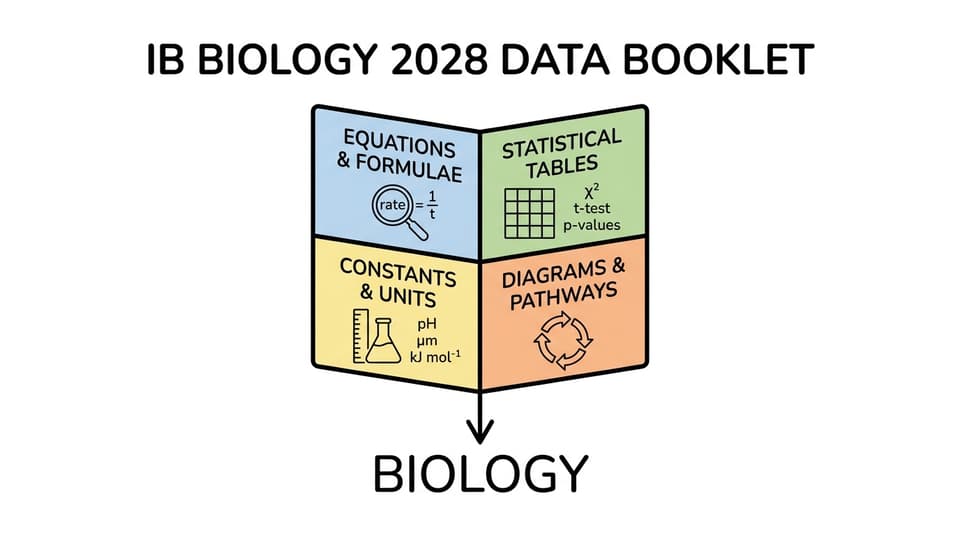
The new resource brings together reference information that students may need while studying and answering examination questions. Its contents include biological and physiological diagrams, physical equations, constants, scientific symbols, unit information and statistical references.
Examples identified in the booklet include structures such as nucleotides, fatty acids and structural polysaccharides, alongside diagrams of a neuron, peristalsis, the lytic and lysogenic cycles, haemoglobin's oxygen affinity and a relaxed sarcomere. It also includes material related to unit conversion, variation in data sets, metric multipliers, hormone abbreviations and other scientific conventions.
This makes the publication broader than a conventional formula sheet. At the same time, it does not provide complete explanations of biological processes, definitions for every syllabus concept or model answers to examination questions.
Students will still need to understand the underlying Biology. The booklet may provide a diagram or equation, but it does not decide which information is relevant, explain the mechanism being tested or construct an answer to a command term such as explain, deduce or evaluate.
Why the IB is introducing the booklet
The official booklet states that supplying reference information is intended to maintain an emphasis on interpretation and application rather than memorization. The 2028 Biology guide also makes direct references to relevant equations, diagrams and other booklet content within syllabus understandings.
In practical terms, this changes what some questions may demand from memory. A student may not need to reproduce a supplied equation or diagram exactly, but they must still recognize when it applies and use it correctly.
For a calculation, that can involve identifying the appropriate relationship, defining the variables, converting units, rearranging the equation and interpreting the result in a biological context. For a diagram, students may need to connect a supplied structure to a process, function or unfamiliar set of data.
The introduction of the booklet should therefore be understood as a change in the balance of skills, not as a reduction in the standard of Biology. Conceptual knowledge, data analysis, scientific vocabulary and examination technique remain important.
Which Biology students are affected?
The booklet applies to students taking the course with first assessment in 2028. It does not automatically apply to students sitting the current Biology examinations before that session.
Examination session | Biology booklet position |
|---|---|
2026 and 2027 | Follow the materials and examination instructions for the current course |
2028 onward | A clean official Biology data booklet is provided for written examinations |
Students should identify their examination session rather than relying only on the year they began studying. If there is uncertainty, the school or Biology teacher should confirm which guide and booklet apply to the candidate's cohort.
The IB Biology subject information page remains the appropriate public starting point for the course overview, but students should use the version supplied by their school for cohort-specific instructions. Unofficial copies may be incomplete, outdated or different from the document used by the school.
What this means for students
For 2028 candidates, the booklet should become a familiar working resource during lessons and revision. Students will likely benefit from knowing the structure of the booklet and the location of common diagrams, equations and statistical information.
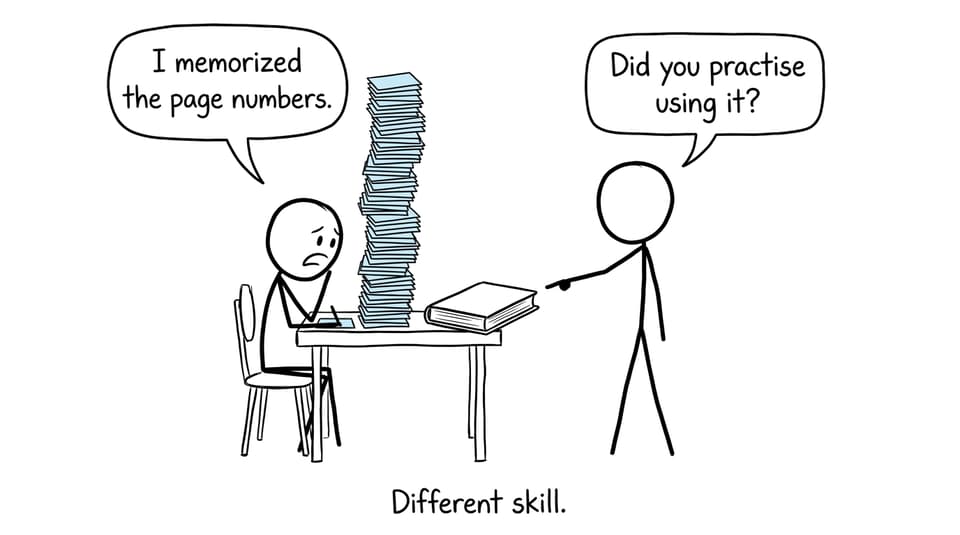
However, familiarity is not the same as memorizing page numbers. Examination questions may require students to decide what information is needed before searching, then apply it under time pressure. A student who spends too long scanning the booklet may lose time, while a student who finds the right equation but misunderstands the biological context may still lose marks.
The change is particularly relevant to data-based questions, calculations involving units or statistics, and questions that use unfamiliar physiological diagrams. The booklet can reduce recall demands, but it does not remove the need to interpret evidence and explain biological relationships.
Students in earlier examination cohorts should not assume that the 2028 booklet will be supplied in their examinations. They should follow the instructions for their own session and check permitted materials with their school.
For a practical breakdown of how the booklet should be used under timed conditions, see How to Use the IB Biology Data Booklet.
Prepare with application-focused Biology practice
The most directly relevant RevisionDojo resource for this update is the IB Biology Question Bank and Exam Practice. Use it with a clean copy of the official booklet to practise identifying relevant information, selecting appropriate equations or diagrams and applying them to exam-style Biology questions.