

An Internal Assessment rarely feels difficult for just one reason. The question may be too broad, the method may be fragile, or the evaluation may sound thoughtful without actually meeting the rubric. Then a teacher writes “develop this further” in the margin, and the real puzzle begins: develop what, exactly?
The short answer is yes: RevisionDojo IA help supports IB students through subject-specific guides, marked exemplars, criteria breakdowns, AI-assisted grading, Jojo AI Chat, and broader revision resources. It can help you understand what the criteria require, diagnose weaknesses in a draft, and decide what to revise next.
It cannot guarantee a grade or replace your teacher. Nor should it produce work that you submit as your own. Its value lies in making the assessment process more visible, so that revision becomes a series of deliberate decisions rather than one long round of guessing.
RevisionDojo internal assessment support at a glance
RevisionDojo brings several forms of IA support into one connected system:
- Subject-specific IA guides explaining structure, criteria, and common mistakes
- Coursework exemplars showing how other students approached authentic assessment tasks
- Criteria breakdowns translating rubric language into practical evidence
- AI grading tools providing provisional, criterion-level feedback on drafts
- Jojo AI Chat for clarifying terminology, methods, analysis, and feedback
- Tutors for human guidance when a problem needs discussion and judgment
- Study Notes, Flashcards, and the Questionbank for strengthening the subject knowledge behind the investigation
- Predicted Papers and Mock Exams for maintaining exam preparation while coursework is underway
The best starting point is the collection of IB Internal Assessment guides. Choose the guide matching your subject and current syllabus, then confirm all formal requirements with your teacher and the subject guide used by your school.
How RevisionDojo helps at each IA stage
A strong IA is rarely written in a single burst. It develops through choices: what to investigate, what evidence to collect, how to interpret that evidence, and what limitations to acknowledge. RevisionDojo is most useful when its tools are matched to those stages.
Choosing and narrowing a workable question
A promising topic is not automatically a workable research question. A science investigation needs measurable variables and a feasible method. A History investigation needs a focused issue supported by sufficiently useful sources. A Mathematics exploration needs mathematics appropriate to the course and enough room for meaningful reflection.
Subject guides and exemplars help you test whether your initial idea has the right scale. Jojo AI can then act as a questioning partner. Rather than asking it to write a research question, ask:
- Which term in this question is ambiguous?
- What data would be required to answer it?
- Which variable or period should be narrowed?
- What practical or ethical limitations could make this unworkable?
The decision must remain yours. That matters academically, but it also produces a better investigation: students generally explain decisions more convincingly when they understand why those decisions were made.
Planning the structure before writing heavily
An IA structure should follow the logic of the task, not merely resemble a generic essay template. RevisionDojo’s guides show how expectations vary by subject, while the IB grading criteria breakdown helps connect broad assessment language to observable evidence.
A useful planning method is to create a criterion map. For each criterion, record:
| Planning question | Evidence to identify |
|---|---|
| What does the criterion assess? | The skill or quality named in the current rubric |
| Where will it appear? | The relevant section, table, calculation, or oral segment |
| What evidence will demonstrate it? | Analysis, justification, interpretation, or reflection |
| What could weaken it? | Missing reasoning, unsupported claims, poor focus, or unclear presentation |
This prevents a common problem: writing a polished report first and trying to attach the criteria afterward.
Reviewing a draft criterion by criterion
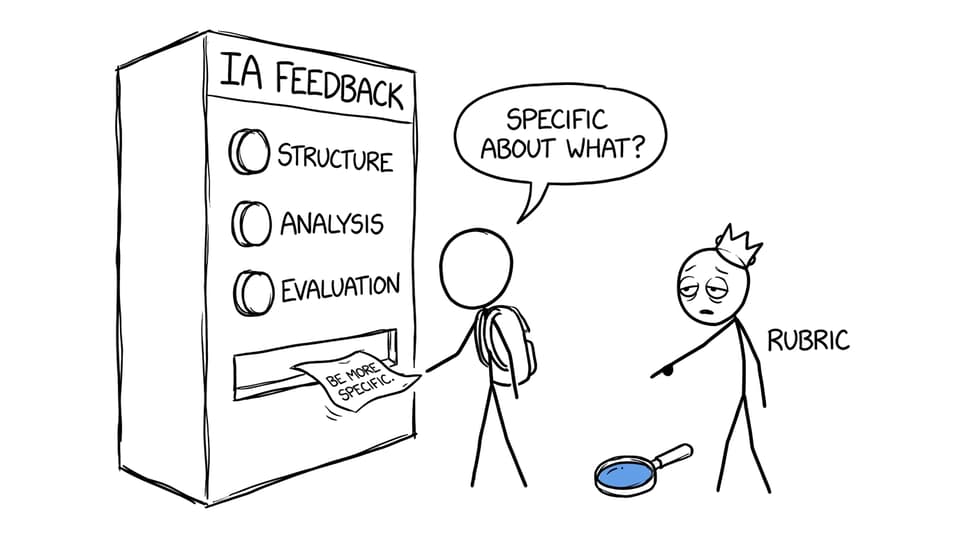
The IB Coursework Grader evaluates supported coursework using the selected subject rubric. Its feedback includes annotations, criterion-level analysis, and suggested priorities for improvement.
Treat the result as diagnostic guidance, not an official mark. Your teacher applies the relevant criteria in your school, and internally assessed work is subject to IB moderation. Moderation exists to check whether assessment standards have been applied accurately and consistently; marks can remain unchanged or be adjusted.
A productive grading cycle looks like this:
- Upload a coherent draft rather than disconnected notes.
- Select the correct subject, level, assessment type, and rubric.
- Identify the two weakest criteria.
- Read the annotations connected to those criteria.
- Revise the underlying reasoning, evidence, or method.
- Check the revised draft against your teacher’s guidance.
Do not respond to every suggestion mechanically. If feedback says an evaluation is limited, determine whether the real problem is missing evidence, weak causal reasoning, an unjustified improvement, or unclear writing. Fixing the diagnosis matters more than changing the sentence.
Subject-specific IA guidance and criteria breakdowns
There is no single universal IA format. Subject-specific support matters because “analysis” means something different in Biology, History, Economics, and Mathematics.
Sciences
In current science investigations, students typically need to demonstrate effective research design, data analysis, a justified conclusion, and evaluation. RevisionDojo’s Biology IA exemplars and Chemistry IA exemplars let students examine how investigations define variables, process results, communicate uncertainty, and evaluate methodological limitations.
The important lesson is not that every report should look identical. It is that claims should follow from data, methodological decisions should be justified, and suggested improvements should address identified weaknesses. Study Notes and Jojo AI Chat can clarify the scientific concepts behind a pattern, while the Questionbank tests whether you can apply those concepts independently.
Mathematics
A Mathematics exploration is not rewarded simply for containing complicated calculations. Students must communicate mathematics clearly, use methods appropriate to their course, and demonstrate reflection throughout the exploration. Depending on the current course guide, criteria also address presentation and personal engagement.
RevisionDojo guidance can help distinguish narration from reflection. “I created a graph” reports an action. Explaining what the graph reveals, why a model behaves unexpectedly, or how a result changes the investigation demonstrates deeper mathematical thinking.
History and other individuals and societies subjects
History requires a focused investigation supported by critical engagement with sources. Students need to distinguish between describing what a source says and evaluating how its origin, purpose, and content affect its usefulness or limitations. The History IA exemplar library provides examples across different topics and achievement levels.
Economics has a different rhythm. Students must connect a selected real-world article to relevant theory, diagrams, terminology, application, and evaluation. The Economics IA exemplars can help students compare how commentaries move from theory to contextual judgment.
Languages, psychology, and other formats
Some internal components are oral, practical, performance-based, or portfolio-based rather than conventional reports. The relevant RevisionDojo guide can explain the format and assessment strands, but students should verify recording procedures, timing, permitted materials, and submission rules with their teacher.
Where a written draft is not the whole assessment, use the platform selectively. AI Chat may help unpack a criterion, Flashcards may reinforce terminology, and a Tutor may help you rehearse analytical reasoning. The tool should fit the task, not force every task into an essay workflow.
How to use IA exemplars without copying
An exemplar is a map of visible decisions. It is not a template to trace.
RevisionDojo’s Coursework Library includes assessed examples across subjects and levels. Students can inspect organization, evidence, analytical depth, and criterion performance. Looking at examples with different scores is often more educational than reading only the strongest work because the contrast reveals what changes between achievement levels.
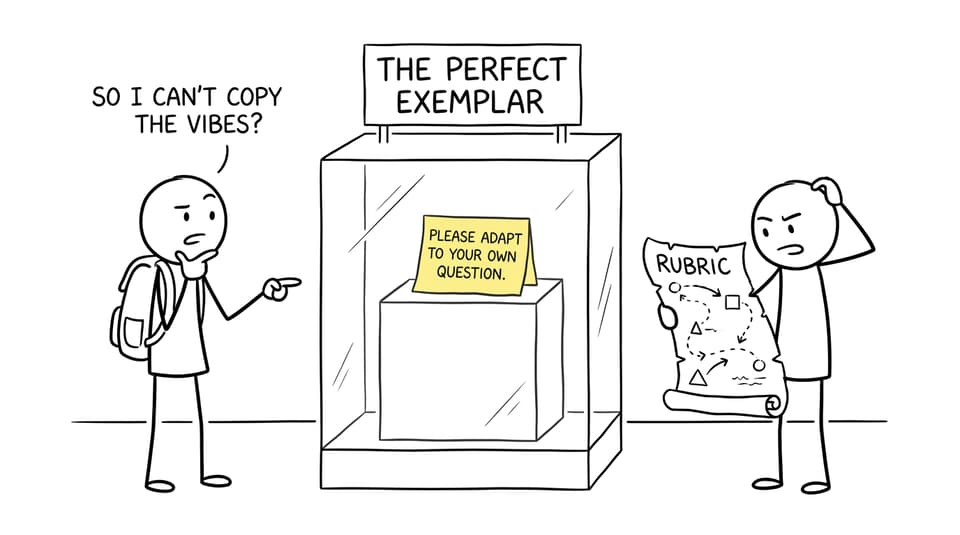
Use an exemplar with a three-column note-taking method:
| Observe | Explain | Adapt |
|---|---|---|
| What choice did the writer make? | Why might it satisfy a criterion? | How can the principle inform your distinct investigation? |
Do not copy wording, arguments, research questions, calculations, data, or distinctive structures. Your investigation must remain your own, and any borrowed material must be acknowledged according to your school’s referencing requirements.
Using AI safely and honestly for an IA
The IB does not impose a blanket ban on AI tools, but it does not regard AI-generated work as a student’s own work. If generated text, images, or graphs are included, they must be clearly credited and appropriately referenced under IB guidance. Schools may also establish more restrictive rules, so your teacher’s instructions matter.
RevisionDojo should therefore function like a feedback system, not a ghostwriter. The guide to using AI safely for an IB IA offers a fuller workflow.
Safe uses may include asking for an explanation of rubric language, identifying questions to consider, testing whether reasoning is clear, or finding weaknesses to inspect. Risky uses include submitting generated analysis, inventing citations or data, disguising copied content, or relying on claims you cannot independently verify.
A simple test helps: could you explain every claim, method, calculation, and editorial decision to your teacher without the tool open? If not, the tool has probably moved from support to substitution.
A practical RevisionDojo IA workflow
The strongest workflow is a feedback loop rather than a last-minute upload:
- Read the relevant subject guide and official criteria used by your school.
- Explore two or three relevant exemplars at different achievement levels.
- Create a criterion map for your own investigation.
- Confirm the question and method with your teacher.
- Draft one complete stage at a time.
- Use the Grader to identify weaknesses, then verify its suggestions.
- Ask Jojo AI to explain unclear feedback without generating submission-ready prose.
- Seek a Tutor when the obstacle requires human judgment or sustained discussion.
- Keep exam preparation alive with short Flashcard and Questionbank sessions.
- Use Mock Exams and Predicted Papers later to rebuild timed performance.
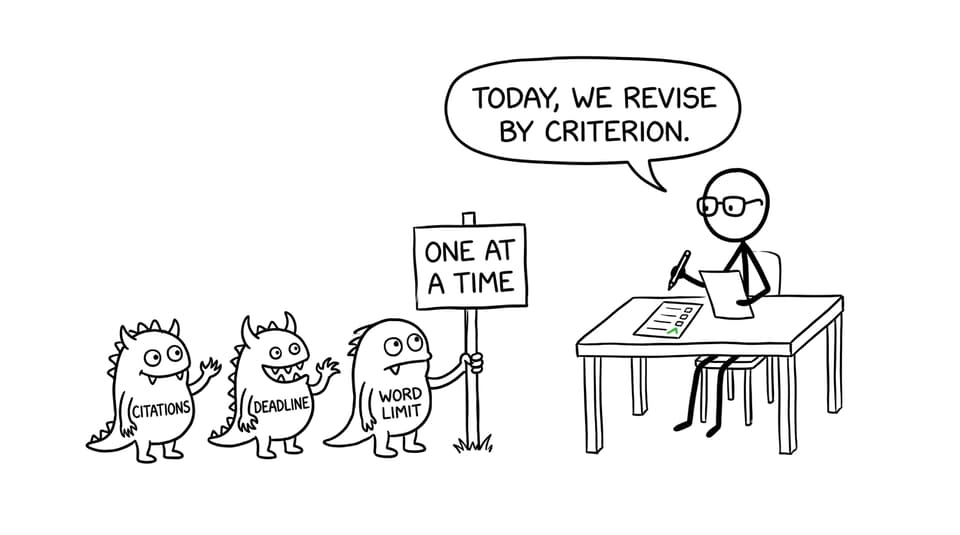
RevisionDojo is most powerful as an integrated IB resource. The Coursework Library shows what quality can look like. The Grading tools reveal where a draft may fall short. Study Notes, Flashcards, and the Questionbank repair the knowledge beneath the writing. AI Chat helps you understand, while Tutors provide human perspective when judgment matters.
Turn uncertainty into a revision plan
An IA becomes less intimidating once it stops being one enormous document and becomes a sequence of evidence-based decisions. Choose a viable question. Understand the criteria. Study exemplars critically. Draft independently. Revise the weakest criterion first.
That is the real value of RevisionDojo IA support: it does not remove the thinking that makes an Internal Assessment yours. It gives that thinking structure. Start with the complete RevisionDojo IA guide collection, select your subject, and turn the next hour into one clear improvement rather than another round of anxious rereading.